

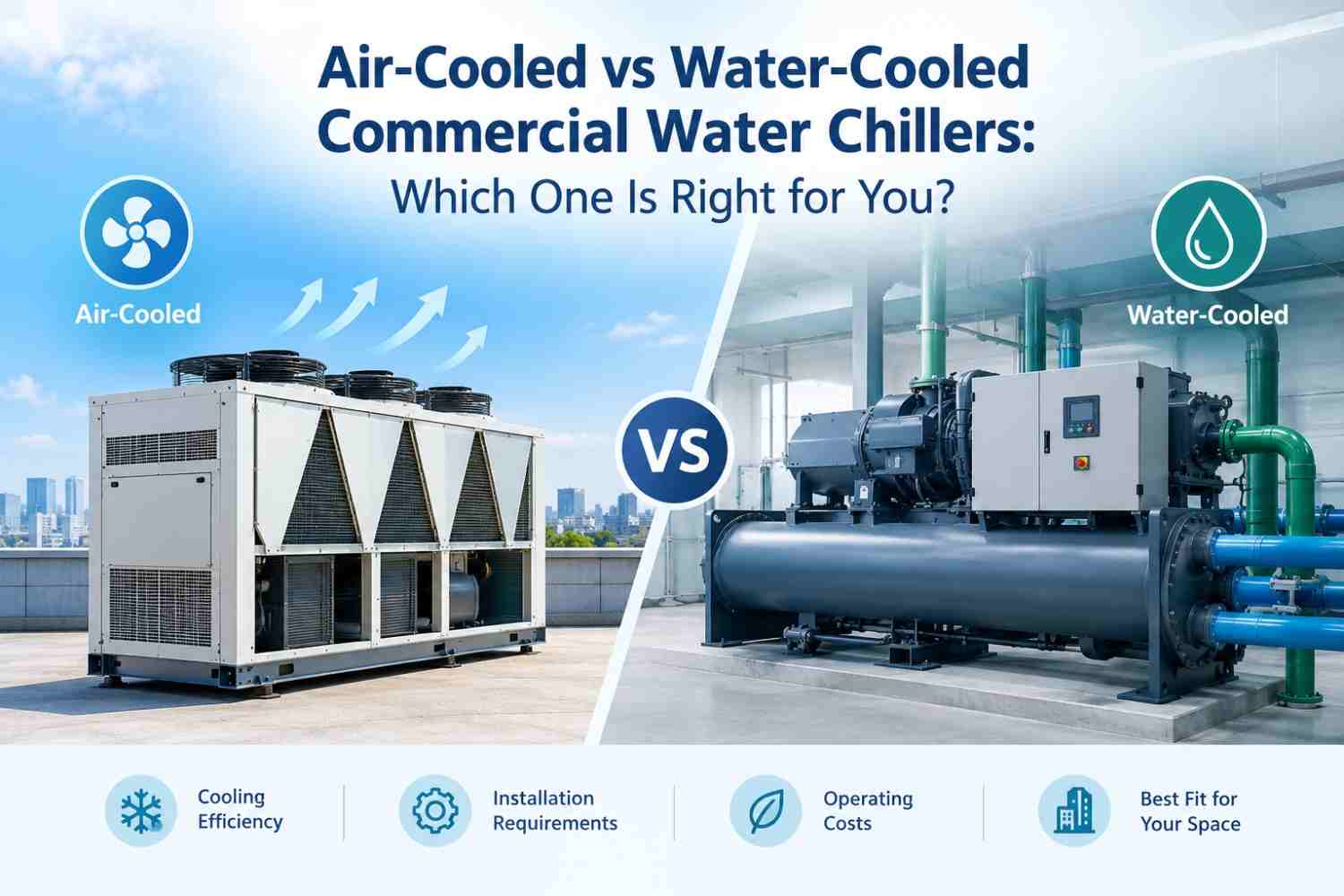
Air-Cooled vs Water-Cooled Commercial Water Chillers: Which One Is Right for You?
Choosing a cooling system is one of the biggest decisions for any factory, hospital, hotel, or office complex. The air-cooled vs water-cooled question comes up in almost every project, and the wrong choice can mean high power bills, frequent breakdowns, and wasted space. At Earth Cooling System, we help businesses compare both options based on real operating conditions. This guide explains the differences so you can decide with confidence.
Understanding Commercial Chiller Types
Commercial chiller types are mainly classified by how they remove heat from the refrigerant, a process called condenser heat rejection. An air-cooled chiller uses fans to push ambient air across the condenser coils. A water-cooled chiller uses water circulated through a cooling tower to carry heat away. This one difference affects cost, efficiency, and maintenance, which is why the air-cooled vs. water-cooled comparison matters so much.
What Is an Air-Cooled Chiller?
An air-cooled chiller consists of a single compact system that can be installed either outside or on rooftops. There is no requirement for a cooling tower or any additional piping system for water, making the installation process easy and fast. For businesses seeking reliable cooling with simpler installation, an air cooled chiller in India can be a practical choice.
Advantages:
- Lower upfront and civil work cost
- No water treatment or tower required
- Simple, easy maintenance
Limitations:
- Efficiency drops in very hot weather
- Fan noise can be higher
- Outdoor exposure may shorten equipment life
What Is a Water-Cooled Chiller?
Heat is transferred from the condenser to the cooling tower in a water-cooled chiller. The performance of a water cooled chiller system remains constant due to the fact that water carries more heat than air. However, water-cooled chiller systems come with some drawbacks because additional hardware is installed along with the water used.
Advantages:
- Higher efficiency at full and part load
- Longer service life, often 20 to 25 years
- Quieter operation and a compact indoor footprint
Limitations:
- Higher initial investment
- Continuous water consumption
- Regular tower cleaning and water treatment
Air-Cooled vs Water-Cooled: Quick Comparison
| Factor | Air-Cooled Chiller | Water-Cooled Chiller |
| Typical capacity | Small to medium (up to about 500 TR) | Medium to very large (100 to 2000+ TR) |
| Efficiency (COP / EER) | Moderate | Higher |
| Installation cost | Lower | Higher |
| Maintenance | Simple | More involved |
| Water use | None | Significant |
| Lifespan | 15 to 20 years | 20 to 25 years |
Chiller Cooling Capacity (TR / kW)
A great deal depends on your load. If your requirement is small to medium, then for the chiller cooling capacity (TR/kW), an air-cooled system would generally suffice without the need for any additional infrastructure. For big buildings or plants of several hundred TR, the water-cooled system emerges as more suitable than the air-cooled system.
Chiller Energy Efficiency (COP / EER)
Efficiency is an advantage of water-cooled chillers. Due to the more stable nature of the water used in the condenser, the efficiency of the chiller will be much higher, especially in warmer regions. If you operate the chiller for 12 to 24 hours per day, then the cost savings from the electricity bill will eventually exceed the initial higher price.
Chiller Installation Cost
Chiller installation cost differs widely between the two. Air-cooled chillers need little beyond a foundation, power, and water piping to the load. Water-cooled systems also need a cooling tower, condenser pumps, extra piping, and a plant room. Always compare the total lifecycle cost, not just the purchase price.
Chiller Maintenance Requirements
Maintenance for an air-cooled chiller is easier because all you have to do is clean the coils, check the fan, and check the refrigerant level. In the case of water-cooled chillers, you will need to clean the condenser tubes, treat the water, and maintain the cooling tower. Not doing this will result in scaling.
Industrial Process Cooling
The control of temperature is vital during the production process in industries like plastics, pharmaceuticals, food processing, and chemicals. Water-cooled chillers work very effectively when handling heavy loads. Air-cooled chillers can be used when there are moderate loads or where there is no water supply.
Choose the Right Cooling Solution with Earth Cooling System
Selecting the appropriate chiller to install in commercial buildings comes down to three main factors: load size, availability of water, and operational hours. Select air-cooled chillers when you require easy installation, low maintenance, and small loads. Go for water-cooled chillers in case of large, continuous loads where high efficiency is required. In case of uncertainty, professional load calculations will clear the doubt.
Final Thoughts
There are obvious benefits to each option. Air-cooled chillers take the lead when it comes to ease of operation and low installation cost, while water-cooled chillers take the lead when it comes to efficiency and longevity.
Here at Earth Cooling System, we have an experienced staff to help you determine which chiller is best for your requirements. Call us today for your free consultation!




Leave a Reply