

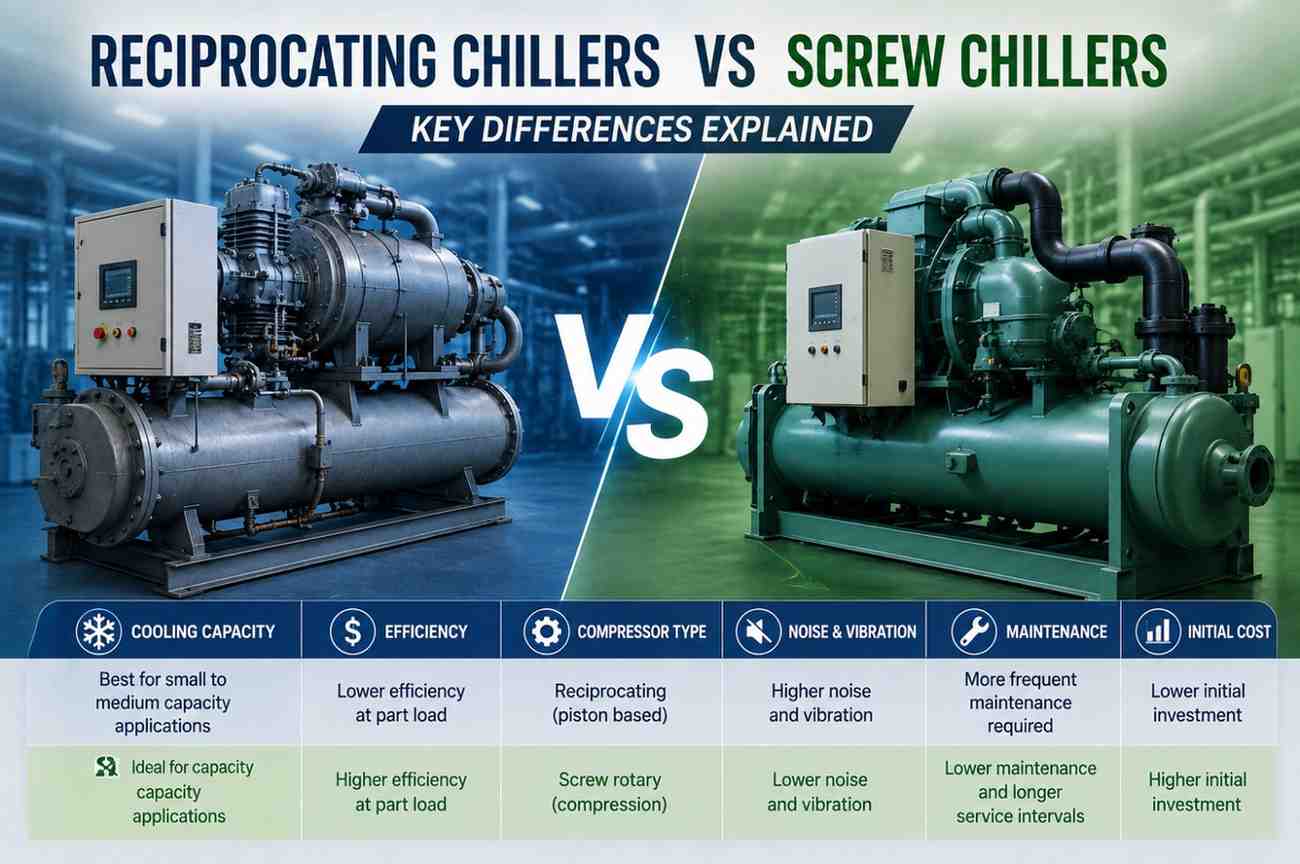
Reciprocating Chillers vs Screw Chillers: Key Differences Explained
Choosing the right chiller is an important decision for businesses that depend on reliable and efficient cooling. Among the commonly used options, reciprocating chillers vs screw chillers is a comparison many facility managers and industrial users consider when selecting a cooling system. While both systems are designed to remove heat from water and provide dependable cooling, their design, operation, efficiency, capacity, and maintenance requirements can be quite different.
At Earth Cooling System, we understand that selecting a chiller is not simply about choosing the most powerful machine. The right choice depends on your cooling requirements, operating conditions, available space, energy consumption, and long-term maintenance needs. This guide explains the major differences between these two technologies to help you make a more informed decision.
What Is a Reciprocating Chiller?
A reciprocating chiller uses a reciprocating compressor to compress refrigerant and support the refrigeration cycle. The compressor operates using pistons that move back and forth inside cylinders. This mechanism makes reciprocating chillers suitable for applications where reliable cooling is required at relatively smaller or moderate capacities.
One of the key advantages of this technology is its ability to provide dependable performance under varying load conditions. Reciprocating systems can also be practical where multiple smaller cooling units are preferred instead of one large system.
What Is a Screw Chiller?
A screw chiller uses a screw compressor containing rotating male and female rotors. As the rotors turn, refrigerant is compressed continuously, allowing the system to deliver smooth and consistent cooling.
Screw chillers are generally well suited for medium- to large-capacity applications. Their continuous compression process can provide stable operation, making them a popular choice for industrial facilities, commercial buildings, manufacturing units, and other locations with significant cooling requirements.
Reciprocating Chillers vs Screw Chillers: Major Differences
When comparing reciprocating chillers vs screw chillers, several factors should be considered rather than focusing on compressor type alone.
1. Compressor Design
So, a reciprocating setup kinda uses pistons in cylinders for compressing, but a screw system uses rotating screw rotors instead. The mechanical design difference really messes with how the refrigerant is dealt with, and also how each one behaves when the load conditions change, like some days it’s smoother and other times it’s not.
2. Cooling Capacity
Reciprocating chillers tend to work well when you have smaller, or at least moderate, cooling needs. Screw chillers, though, are usually the choice in situations where you need a higher, and also pretty continuous cooling capacity.
Therefore, your required cooling load should be one of the first considerations when evaluating reciprocating chillers vs screw chillers.
3. Efficiency and Performance
Chiller efficiency and performance depend on several factors, including operating load, temperature conditions, system design, maintenance, and compressor technology.
Screw compressors can provide efficient performance for applications operating at relatively consistent and higher loads. Reciprocating systems can also perform efficiently when appropriately sized and operated within their intended conditions.
There is no universal winner when comparing reciprocating chillers vs screw chillers because actual efficiency depends heavily on the application and operating profile.
4. Maintenance Requirements
Reciprocating compressors have moving piston parts that need regular checkups and routine care to keep things right. Screw compressors instead rely on fewer big moving components, so the whole unit can run more smoothly and stay dependable for longer, even with heavy use.
But even with all that, proper upkeep is still pretty essential for both technologies. Doing regular refrigerant checks, heat exchanger cleaning and lubrication inspection, plus electrical checks, and also performance monitoring can help lengthen the service life of the equipment, in a kind of steady way.
5. Application and Installation
Reciprocating chillers can be, kind of a workable choice for use cases where the cooling load is moderate, and you also need that flexibility. Meanwhile, screw chillers are usually the better bet for bigger facilities, like places that run continuous industrial cooling, or in other words, where the operation is always on.
Choosing between a reciprocating chiller and a screw chiller should really be driven by things like the cooling capacity, how many hours they’ll run, space to fit everything, the energy demand, and what you plan to expand later on.
Reciprocating vs Screw Compressor: Which Is Better?
There is no single answer to which compressor is better. A reciprocating compressor can be advantageous for specific capacity ranges and applications, while a screw compressor can be more appropriate for continuous, higher-capacity cooling.
For businesses running industrial chiller systems, the big picture of the whole setup is almost as important as the compressor. Getting the sizing right, plus the installation layout, the control logic, and the way heat is rejected really matter, too. And then there’s the day-to-day maintenance part, which can make a big difference in operating costs and also in long-term reliability.
When evaluating reciprocating chillers vs screw chillers, businesses should consider both their current cooling requirements and expected future needs.
How to Choose the Right Chiller?
Before investing in a chiller, consider the following factors:
- Required cooling capacity
- Desired operating temperature
- Daily and seasonal cooling load
- Energy efficiency requirements
- Available installation space
- Maintenance requirements
- Initial investment and operating costs
- Expected operating life
- Future capacity requirements
If your facility requires specialized cooling, consulting an experienced cooling-system provider can help you select a properly sized and suitable solution.
Final Thoughts
Figuring out how reciprocating chillers differ from screw chillers can make the selection go a lot smoother, honestly. In general, reciprocating equipment tends to work best for smaller to moderate cooling duties, while screw chillers are usually the better fit for big capacity needs and steady, nonstop cooling demands.
The best option really depends on your facility’s cooling load, day-to-day operating conditions, energy goals, budget, and what kind of maintenance expectations you have. For businesses that need dependable cooling solutions, Earth Cooling System can help take a look at the application and then suggest an appropriate chiller solution, kind of based on your needs.
Explore our range of reciprocating chillers for reliable cooling solutions, or consider industrial water chillers in Delhi for demanding industrial and commercial applications.



Leave a Reply