

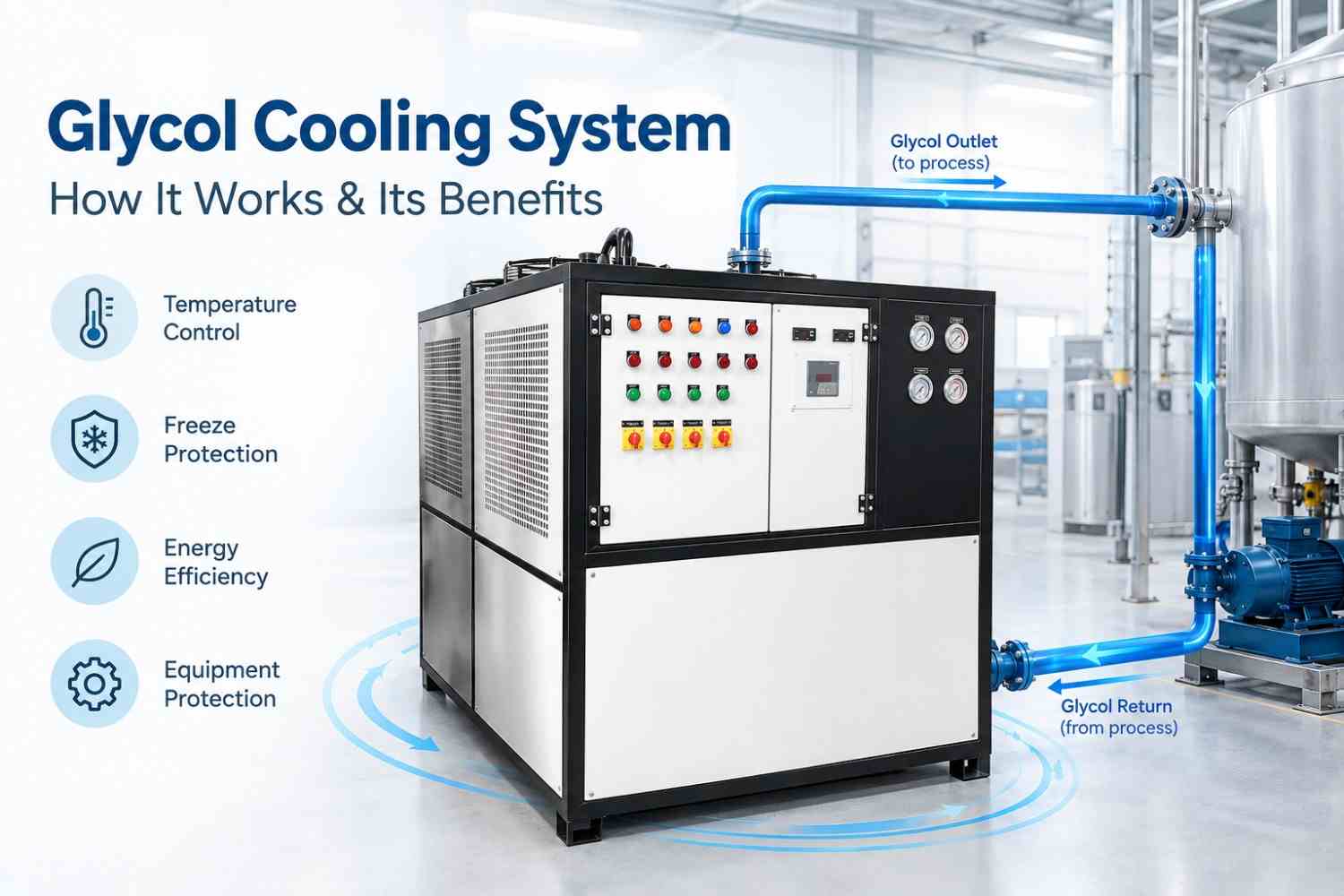
What Is a Glycol Cooling System? How It Works and Its Benefits
When precise temperature control is important for industrial processes, commercial refrigeration, food production, and other applications, conventional cooling systems may not always provide the required performance. A glycol water chiller offers an efficient solution by using a mixture of water and glycol as the cooling fluid. This combination helps prevent freezing while maintaining stable temperatures in demanding cooling environments.
At Earth Cooling System, glycol-based cooling solutions are designed to support reliable temperature management across different industrial and commercial applications. Understanding how these systems work, where they are used, and why glycol is added to chilled water can help businesses select an appropriate cooling solution for their requirements.
What Is a Glycol Cooling System?
A glycol cooling system is a chilled-water system that uses a mixture of water and glycol instead of plain water as the circulating coolant. Glycol lowers the freezing point of the fluid, allowing the system to operate at temperatures where ordinary water could freeze.
The glycol water chiller keeps the glycol water cool as it passes through the closed loop circuit. This cooled glycol water will absorb the heat from the process or equipment and goes back to the chiller where the heat will be extracted from the fluid.
The concentration of the glycol depends on the operating temperature that is needed for its functioning and application purposes. The glycols that are commonly used are ethylene glycol and propylene glycol.
How Does a Glycol Chiller Work?
Understanding how does a glycol chiller work begins with the basic refrigeration cycle. The chiller removes heat from the glycol-water mixture and transfers that heat away through the refrigeration system.
The process generally follows these stages:
1. Cooling the Glycol Mixture
The refrigeration circuit extracts heat from the glycol-water solution through the evaporator. As the refrigerant absorbs this heat, the glycol mixture reaches the required chilled temperature.
2. Circulating the Chilled Fluid
A pump sends the cooled solution through insulated pipes toward the equipment, process, or heat exchanger requiring cooling.
3. Absorbing Process Heat
The chilled glycol absorbs heat from the application. Depending on the setup, it may cool manufacturing equipment, storage systems, fermentation tanks, food-processing equipment, or other temperature-sensitive processes.
4. Returning to the Chiller
After absorbing heat, the warmer glycol solution returns to the chiller. The refrigeration system removes the accumulated heat, and the cycle starts again.
This continuous circulation allows a glycol water chiller to provide consistent cooling for applications requiring controlled temperatures.
Why Is Glycol Used in Chilled Water Systems?
One of the main purposes for the use of glycol in a chilled water system is because it lowers the freezing point of the circulating fluid. This is important if the system requires that the operation take place below the freezing point of water.
Glycol for use in chilled water systems must be chosen very carefully as not using enough of it will not afford adequate freezing protection, whereas having too much will reduce heat transfer efficiency and the need to pump.
This makes correct glycol selection and system design important for achieving efficient operation.
Key Benefits of a Glycol Chiller System
A properly designed glycol chiller system can provide several advantages for industrial and commercial applications.
Improved Freeze Protection
Glycol reduces the freezing point of the circulating solution, helping protect the cooling loop when low temperatures are required.
Stable Temperature Control
Glycol water chillers may provide constant temperatures for cooling, making them applicable for operations that could be adversely impacted by temperature changes.
Suitable for Low-Temperature Applications
Glycol-based systems are particularly useful where cooling requirements extend below the freezing point of water. This makes them suitable for several specialized industrial and refrigeration applications.
Closed-Loop Cooling
The coolant can circulate continuously through a closed loop. This can help create a controlled cooling environment while reducing the need for continuous replacement of the cooling fluid.
Versatile Applications
A glycol chiller system can be configured for different cooling requirements. Depending on capacity and design, these systems can support food processing, beverage production, cold storage, pharmaceutical applications, manufacturing, and process cooling.
Where Are Glycol Cooling Systems Used?
Glycol cooling systems are commonly considered for applications that require reliable and controlled cooling. Food and beverage facilities may use them for process cooling and temperature-sensitive production. Breweries and beverage manufacturers can use glycol-based systems for applications where controlled low temperatures are important.
They can also be used in industrial manufacturing, pharmaceutical processes, chemical production, cold-storage environments, and specialized HVAC applications.
It is important to note that the right size of a glycol water chiller should be based on various considerations like cooling load, desired temperature, glycol ratio, flow rate, among other things.
Glycol Water Chiller vs. Conventional Chilled Water Systems
A traditional chilled water system usually employs water as the fluid for circulation, whereas a glycol system uses a mixture of water and glycol. The most important benefit that glycol provides is its low freezing temperature.
However, glycol solutions can have different heat-transfer and flow characteristics compared with plain water. Therefore, the system should be properly sized for the selected glycol concentration.
Businesses evaluating cooling options can also explore an Air cooled water chiller when their application requires a conventional water-based cooling solution.
Choosing the Right Glycol Chiller
A choice of an appropriate glycol water chiller goes beyond selecting one based on its cooling capacity. Factors to be taken into account include temperature requirements, glycol type and concentration, cooling load, flow requirement, installation site, among others.
Professional system assessment can help determine the appropriate configuration and reduce the risk of inefficient operation. Earth Cooling System can help businesses evaluate their cooling requirements and identify suitable chiller solutions.
For businesses specifically searching for a Glycol Chiller in India, understanding the application’s temperature and load requirements is an important first step before selecting equipment.
Conclusion
The glycol-based cooling system makes up a viable option in instances where there is a need for low temperatures to be achieved. This is done by circulating a glycol-water mixture through the refrigeration cycle, which makes it possible for a glycol-water chiller to provide protection from freezing.
In the manufacturing of food and drinks, as well as in industries and specialized purposes, an appropriate glycol chiller system will help ensure an effective cooling system in the process. With the appropriate amount of glycol, capacity of the chiller, flow rate, and operating temperature, an efficient cooling system can be established according to business needs.

Leave a Reply